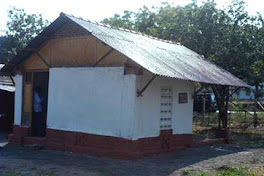
I kept watching, as having eaten the Rat-poison the day before (dutyfuly distributed by me) the ever so elusive rat was gasping for his last breaths and parched himself on the sink in our kitchen. It was part fear, part repulsion and part shame that i avoided even going near the sink, let alone think of doing something about the dying rat.
And as i kept thinking about the whole episode and my attitude to the dying rat, a set of thought was set in motion; what was happening inside myself, while i waited for the rat to take his last breath and die in the sink, waiting for an ‘aid’ to come and help me get rid of the ‘carcass’ .
The idea to deal with what is ugly, the filthy or the rotten makes me uneasy, restless and agitated so i try to postpone or procrastinate it, try so tha someone else may do the ‘dirty-job’.
I realised that i avoid anything that involves ‘getting my hands dirty’, to deal with the ugly, the filthy and the unwanted part of the story; the death, loosing battles, the oncoming disasters (physical, emotional, social as well economical) and sheer rottenness in the middle of our political and governance systems in India. I distaste and ignore what is the darker side of anything.
By choosing to ignore death, i am trying to ignore the very nature of life ‘death’ and in the process avoiding the guilt that may come for not doing anything for it. I always think of an Ostrich, who during the storm prefers to sink his head in sand, wanting to ignore it.
Fear, is my companion from childhood, I may not show it outwardly and may want to ignore it, but it will surface at the most mundane acts of daily life, like watching a scary-movie and just when its a show-time for dear ghost/vampire i will close my eyes, knowing full well that its going to come out in hideous forms.
And this fear, haunts my decision, the choices the actions consciously or sub-consciously. Why am i afraid? Of what am i afraid? I keep asking these questions, but with no answer.....
Sunday, August 1, 2010


Saturday, April 11, 2009
Shashi Tharoor and Electoral battle as backdoor entry in the Mainstream Governance
Shashi Tharoor, sometimes writes eloquently, i enjoyed reading his book 'The Great Indian Novel', that seemed to understand the Freedom struggle in the light of the epic story of Mahabharat.
After 29 years in the United Nations, and a lost bid for post for Secretary General of United Nations, Mr. Shashi Tharoor has come back to India and is contesting an election to seek what he termed as 'Rebooting of Self'.
Loosing a high-pitched battle, which seemed almost won-over at one point, is not easy to get over with and that to one for such a high-profile post like secretary general of United Nations. even though at many times it is made obsolete by dictates coming from Washington-London and Moscow, add to it Beijing now.
Initially i could not fathom a reason why mr. Shashi Tharoor has decided to contest a Loksabha Elections in India. The elections in India generally become murkier, high-pitched, demanding a series of compromises, voicing of opinions 'one may not really believe' and harnessing the divide within society for sake of democratic victory.
Looking through the prism of reasoning, i presume, that Mr. Shashi Tharoor is not really bothering about the electoral victory. The election for Loksabha, for Mr. Tharoor looks more like a stepping stone which will pave his way into the power corridors in New-Delhi, if the Congress (I) emerges as the single largest party after the polls.
Battling the contest for the Loksabha will help install Mr. Tharoor in the middle of political spectrum. This will also help prepare a ground for the congress, if tomorrow Congress I wants to induct him into the Government. Mr. Tharoor then can become a Rajyasabha candidate from any part of India, and blissfully get absorbed in the central-government.
Imagine, that After few months, if Congress would have suddenly invited Mr. Tharoor to hold a prestigious post in ministry, there would have been huge hue-and-cry. But now the sailing would be lot smoother.
Monday, March 30, 2009
'Mahabharata' and Great Indian battle for Electoral supremacy
'Mahabharata', An Epic that probably has few parallels in the literature, ancient or modern, in its enormity, complexity and spread (over geography, cultures, civilizations and emotions).
The central or the constant undercurrent throughout the journey called Mahabharat lies the omni-present human life-force of 'Play by Power'. In most parts the story is about everything that happens in the process of gaining-loosing power, a constant struggle to achieve power or to maintain power. The struggles within myriad tales of Mahabharata are about struggles between 'Dharma-Adharma', the 'righteousness and selfishness', the 'greater common good', the search for consciousness within the confines of daily life, so on and so forth.
The central or the constant undercurrent throughout the journey called Mahabharat lies the omni-present human life-force of 'Play by Power'. In most parts the story is about everything that happens in the process of gaining-loosing power, a constant struggle to achieve power or to maintain power. The struggles within myriad tales of Mahabharata are about struggles between 'Dharma-Adharma', the 'righteousness and selfishness', the 'greater common good', the search for consciousness within the confines of daily life, so on and so forth.
A cursory look at the electoral democratic system in India over last few decades and the whole political-process appears nothing but the constant struggle for 'Power', unlike Mahabharata, this power struggle has become too crass in its content as well in the means.
The large proportion of Political leadership in India, appears to have abysmally low clarity in understanding the social, environmental, ecological, economical, technological, financial, cultural or any other dimension of the society. The comprehension of the issues and national threats, opportunities or projected social-scenario's is always within the framework of 'self-appropriation'.
Political party's, individual partymen or election-contestants, news-media managers, and all the stake-holders in this 'power-play' invariably innovate, sometimes knowingly, sometimes by-chance, sometimes unknowingly. i wondered why not try and track the whole electoral process and look for sparks of innovation within the process.
Mahabharata will provide us a backdrop to contextualize and understand some of the 'innovations' that could prop-up as we go along. Innovations within electoral contests, might as well provide us the clues for the vibrancy in the political framework within our society.
Subscribe to:
Posts (Atom)